Personality as Power: The RPGs That Turn Character Flaws into Game-Changing Mechanics
Modern RPGs like The Outer Worlds and Persona elevate personality systems beyond flavor, transforming character flaws and social bonds into core gameplay mechanics.
In the ever-evolving landscape of role-playing games, where players crave more than just stats and skill trees, a new frontier has emerged: the personality system. No longer mere flavor text, a character's disposition, vices, and virtues have become as critical to success as a finely honed blade or a powerful spell. As we stand in 2026, the legacy of RPGs that dared to make personality matter has only grown more profound, transforming internal conflicts into external power and turning character creation into a soul-searching exercise. These games don't just let you play a role; they force you to become it, with every decision etching a permanent scar or a shining virtue onto your digital soul. The result is an experience as unpredictable and rich as human nature itself, where a hero's greatest enemy can sometimes be their own reflection.
🎭 The Art of the Flaw: When Weakness Becomes Strength
The most revolutionary systems understand that perfection is boring. The Outer Worlds pioneered this philosophy with its Flaw system, a masterstroke of game design that treats personality quirks like a volatile, high-yield currency. Accepting a flaw—be it a crippling fear of robots or a debilitating addiction—slaps a permanent debuff on your character. Yet, in return, it grants a precious Perk Point. It’s a Faustian bargain where your character's psychological baggage is as meticulously packed as their inventory. This system transforms the journey from one of minimizing weaknesses to strategically curating them, like a collector seeking out rare, cursed artifacts for their unique utility. Your character isn't just built; they are sculpted from their own fractures and fears.
🏫 The Social Simulator: Building a Persona, One Link at a Time
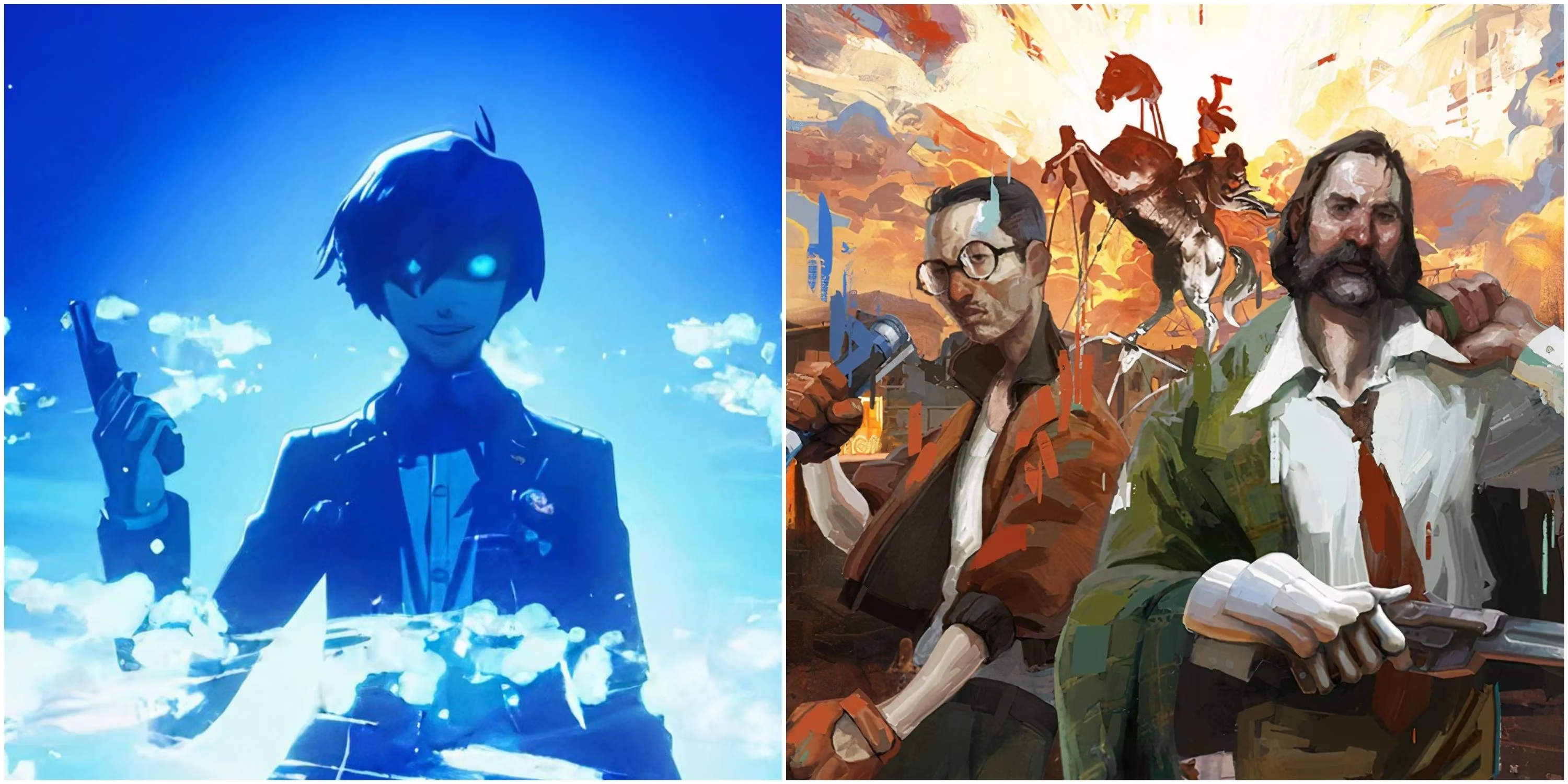
Meanwhile, the Persona series, with Persona 3 as its pivotal cornerstone, approached personality not as a stat but as a lifestyle. Here, personality development was a slow, organic drip-feed, as integral to progression as dungeon crawling. By engaging in Social Links—whether by devouring a mountain of burgers or belting out off-key karaoke—players didn't just raise numbers; they watched their protagonist's social stats (Knowledge, Courage, Charm) blossom. This wasn't mere menu navigation; it was life simulation where your after-school activities were as consequential as your combat tactics. Unlocking new Social Links felt less like gaining an ally and more like earning a key to a previously hidden chamber of the human heart. The protagonist's personality became a living tapestry, woven from every conversation and shared meal.
😱 The Psychology of Survival: Stress, Scars, and Sanity
For a truly harrowing look at personality under pressure, few games match the oppressive genius of Darkest Dungeon. Here, personality isn't developed; it's eroded and reforged in the crucible of cosmic horror. Party members don't just take hit point damage; they accumulate Stress, leading to Afflictions like "Paranoid" or "Abusive." A once-valiant crusader might become a coward, hiding in the shadows while their comrades fall. Conversely, a character might find a hidden reservoir of strength and become "Vigorous" or "Courageous." This system makes every expedition a psychological thriller. Managing your party's mental state becomes as crucial as managing their health, turning the roster screen into a grim psychiatric ward where hope and despair battle for dominance. Your party's collective personality is as fragile as a soap bubble in a storm, and just as beautiful when it holds.
⚖️ The Moral Compass: Personality as Narrative Driver
Classic-inspired CRPGs like Pillars of Eternity and Divinity: Original Sin took a more narrative-driven approach. In Pillars of Eternity, your actions as the Watcher silently built a reputation—Cruel, Benevolent, Clever, etc. This invisible personality score would then unlock unique dialogue options and change how the world reacted to you. A just ruler might bypass persuasion checks through sheer respect, while a cruel one could intimidate with a glance. Your personality became a key that could open doors or slam them shut, a silent negotiator working in the background of every conversation.
Divinity: Original Sin added a brilliant layer of interpersonal drama with its dual protagonists. By assigning personality tags like "Idealist" or "Pragmatist" at creation, players could set the stage for dynamic, unscripted arguments between their own heroes. Watching your carefully crafted characters debate the ethics of a decision was like hosting a lively, unpredictable debate society in your own head. It proved that the most compelling conflict could be between the two voices of the player's own conscience.
👑 The Ruler's Burden: Personality as Political Reality
In the grand strategy epic Crusader Kings 3, personality is the very engine of state. Your ruler isn't a blank slate; they are a complex web of Traits like "Gregarious," "Paranoid," or "Lustful." Acting in accordance with these traits is smooth sailing. But forcing a Compassionate king to execute a prisoner, or a Craven emperor to lead a charge, builds Stress. Too much stress leads to breakdowns and negative traits. Governing an empire thus becomes an exercise in managing your avatar's mental health as much as your vassals' loyalty. Your personality is the cage within which you must rule, a set of psychological laws as binding as any feudal contract. It turns dynastic management into a centuries-long therapy session.
🧠 The Blank Slate: Rebuilding a Shattered Self
Perhaps no game has made personality its entire playground quite like Disco Elysium. Starting as an amnesiac detective, you literally rebuild your personality from the ground up by investing in 24 different skills that represent aspects of your psyche—from Encyclopedic knowledge to your own shivering Volition. These skills don't just succeed or fail checks; they argue with you, offering contradictory advice and insights. Choosing to internalize certain "Thoughts" can permanently alter your capabilities and worldview. Will you become a Communist superstar cop or an apocalypse-obsessed art critic? The game is less about solving a murder and more about the archaeological dig of uncovering—or inventing—who you are. Your personality is the ultimate crime scene, and you are both the detective and the victim.
🧌 The Nemesis Within: Personality as Procedural Drama
Finally, Middle-earth: Shadow of Mordor (and its successors) externalized personality in its legendary Nemesis System. Here, it was the enemies who had rich, procedurally generated personalities. An Orc captain might be "The Poet," reciting bad verse before attacking, or "The Beast-Slayer," immune to animal attacks. Their personalities dictated their strengths, weaknesses, and even how they reacted to you—a captain you humiliated might return scarred and vengeful. This system made every enemy a potential character in your personal saga. The personality of your foes created emergent narratives more compelling than any scripted quest, turning the open world into a stage for endless, personalized drama.
| Game | Core Personality Mechanic | The Player's Role |
|---|---|---|
| The Outer Worlds | Trading Flaws for Perk Points | Strategic Self-Saboteur |
| Persona 3 | Social Stats & Link Development | High School Life Coach |
| Darkest Dungeon | Stress & Affliction System | Trauma Therapist |
| Pillars of Eternity | Reputation-Based Dialogue | Moral Architect |
| Divinity: Original Sin | Inter-Character Debate | Marriage Counselor for Your Own Party |
| Crusader Kings 3 | Trait-Driven Stress Management | Royal Psychiatrist |
| Disco Elysium | Skill-Based Internal Dialogue | Amnesiac Sculptor of Self |
| Shadow of Mordor | Procedural Enemy Personalities | Director of an Orcish Soap Opera |
In conclusion, the RPGs that master personality mechanics offer something far greater than power fantasy. They offer a mirror. They understand that a character's greatest battles are often fought not on a battlefield, but in the quiet spaces between decisions, in the accumulation of stress, and in the slow, painful process of becoming. These systems treat personality not as a static selection at creation, but as a dynamic, living entity—as malleable as clay yet as defining as a skeleton. They prove that in the right digital hands, our flaws can be our most powerful equipment, our vices can be viable build options, and the journey to define a character is, ultimately, a journey to understand a sliver of ourselves. As we look to the future of RPGs in 2026 and beyond, the lesson is clear: the deepest dungeons to explore and the most rewarding quests to complete are the labyrinths of the human heart and mind. 🧠⚔️✨