2024’s Critical Darlings: How Astro Bot and a Deck of Cards Redefined Gaming
OpenCritic's 2024 highest-rated games crowned Astro Bot with a 95, as inventive hits like Balatro and Metaphor: ReFantazio reshaped expectations.
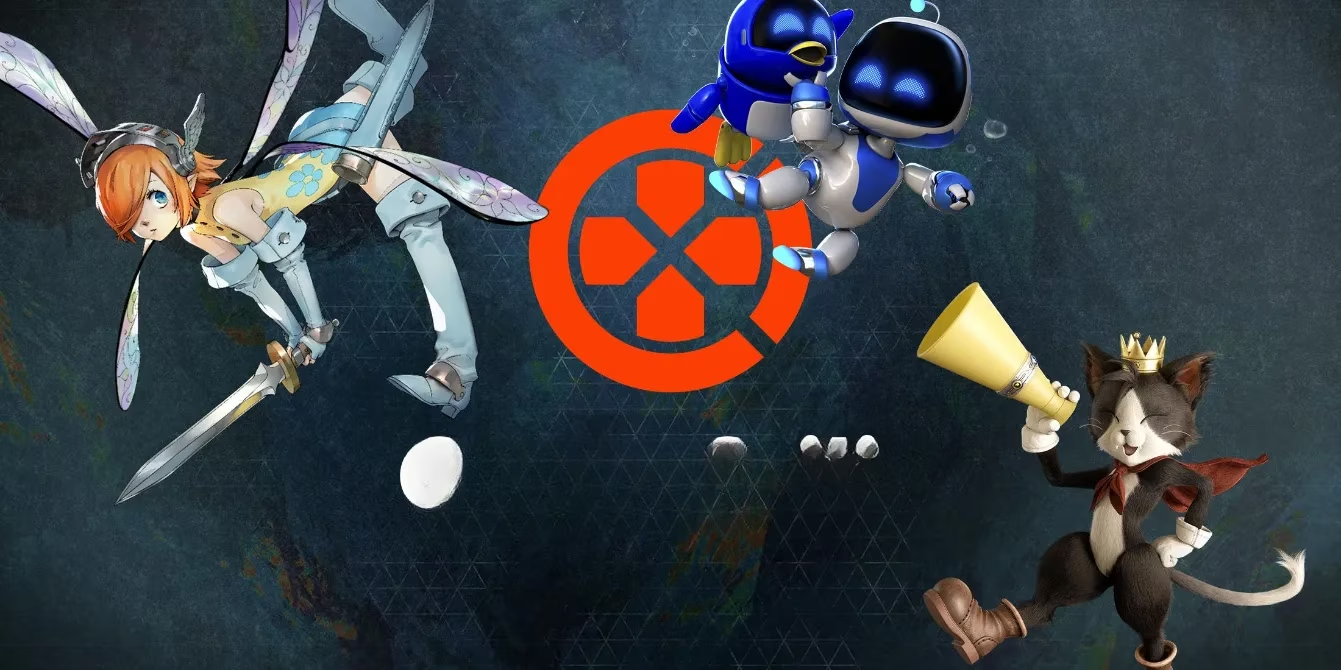
In the constantly churning cosmos of video games, 2024 did not merely spin quietly—it detonated like a miniature supernova of creativity, scattering star-bright titles across every platform. Review aggregate site OpenCritic tracked the luminosity, and standing at the center of that explosion was the PlayStation 5 exclusive Astro Bot, which soared to a 95 overall rating. It was a year where a small robot’s platforming adventure could tower over massive RPG epics, and where a poker-inspired roguelike could steal hearts as deftly as a street magician palming a coin.
Astro Bot’s triumph felt less like a calculated industry move and more like a caffeinated hummingbird weaving through a neon tapestry—every level a burst of color and tactile joy that seemed to reinvent the 3D platformer with a grin. Yet the top 10 highest-rated new releases of 2024, as compiled by OpenCritic without counting remakes, remasters, or DLC, painted a picture of a year shaped by bold reinvention rather than iterative safety.
The Titanium-Strength Top 10
- Astro Bot – 95
A masterclass in charm, the game turned the DualSense controller into a percussion instrument of delight, proving that pure fun remains the industry’s most renewable resource.
- Final Fantasy 7 Rebirth – 93
An orchestral reimagining that expanded Midgar’s outskirts with the narrative muscle of a serialized epic. Its open zones and character-driven arcs earned a standing ovation from critics.
- Metaphor: ReFantazio – 92
Atlus fused medieval fantasy with a restless political heartbeat, creating an RPG that felt like a feverish chess match played on a board that kept reshaping itself.
- Balatro – 91
This deck-building roguelike became the poker-faced siren of the year, luring players into a hypnotic loop of joker combos and multiplying points until sleep became an afterthought.
- Satisfactory – 91
Coffee Stain’s factory-building sandbox finally launched into 1.0, and the result was a cathedral of conveyor belts that let engineers worship at the altar of efficiency.
- The Crimson Diamond – 90
A text-parser adventure draped in EGA-era aesthetics, it was a love letter typed on a rattling keyboard, proving that nostalgia can be a scalpel as sharp as any modern engine.
- Tekken 8 – 90
The Iron Fist franchise slammed back with the aggression of a monsoon, its Heat System turning every round into a controlled detonation of combos and cinematic drama.
- UFO 50 – 90
A capsule collection of 50 entire games, this was a time machine disguised as a cartridge, each title a fossilized spark of an alternate 1980s gaming timeline.
- Like a Dragon: Infinite Wealth – 90
Ichiban Kasuga’s Hawaiian adventure delivered turn-based combat with the emotional range of a telenovela and the eccentricity of a fever dream, complete with a Pokémon-like job system.
-
Animal Well – 89
A labyrinthine pixel-art puzzle box that whispered secrets in the dark; every screen was a riddle waiting to be cracked by moonlight.
Beyond the top 10, gems like ONE BTN BOSSES (89), 1000xRESIST (89), and Unicorn Overlord (88) demonstrated that 2024 was not a monoculture but a thriving ecosystem. Indie darlings and veteran studios alike contributed to a list that felt, in hindsight, like a crate of fireworks—each unique, yet collectively dazzling.
When DLC and Remasters Reorder the Cosmos
The rankings shifted dramatically once expansions and revamps entered the equation. Had DLC been permitted, Elden Ring’s Shadow of the Erdtree would have commandeered second place with a 94, its contested Game of the Year nomination at The Game Awards 2024 becoming a lightning rod for debate over what qualifies as a standalone achievement. Vampire Survivors: Ode to Castlevania matched that 94, while Destiny 2: The Final Shape’s 91 would have muscled into the top 10. The exclusion of early access titles also kept Hades 2 in the waiting room, a decision that sparked endless forum threads but ultimately preserved a clear focus on finished work.
A Year That Remapped the Compass
Looking back from 2026, the 2024 slate can be seen as a compass recalibration. Astro Bot reminded the industry that a concentrated burst of unadulterated play could outsell and outshine sprawling open worlds. Balatro proved that a single developer with a warped deck of cards could hypnotize millions. And Metaphor: ReFantazio showed that the turn-based skeleton still had marrow to give. Meanwhile, the chilling Silent Hill 2 remake (87) and the ambitious but divisive Dragon’s Dogma 2 (87) underscored that even remakes and sequels could brand fresh scars into the year’s memory.
The GamesBeat summit in early 2025 would later call 2024 “the year of concentrated novelty,” a phrase that stuck. It was a period when graphical arms races took a backseat to sheer mechanical inventiveness—a pivot that the incoming console generation would amplify.
From 2025’s Promises to 2026’s Reality
When critics sealed their 2024 lists, they cast eager glances toward 2025. The industry was buzzing with expectations: Nintendo’s Switch 2 launch, Rockstar’s Grand Theft Auto 6, and a cascade of other blockbusters. From our vantage point in 2026, those predictions unfolded with mixed accuracy. The Switch 2 did indeed arrive in mid-2025, dragging a wave of high-definition remasters and a surprise new 3D Mario that landed on OpenCritic with a 94. Grand Theft Auto 6, however, slipped into early 2026 after a white-knuckle development finish, but its eventual debut shattered sales records and split critics down the middle—a metallic behemoth that for some felt like too familiar a diamond.
Other 2025 titles reshuffled the all-time greats. A new IP from the Hades team, a roguelike tactical ballet codenamed “Iron Choir,” brushed a 95. The indie scene erupted with Blue Suede Stranger, a noir puzzle-platformer that married a saxophone soundtrack to time-loop mechanics, earning a cult 93. In this new context, 2024’s roll call no longer stands alone; it became the overture to an era where mid-budget experimentation is no longer the understudy—it’s the lead.
The Legacy in Pixels
Returning to the 2024 OpenCritic tableau, the image that resonates most is that of a single small robot tumbling through a planet-hopping celebration of PlayStation heritage—a mascot that, for a moment, united critics who rarely agree on anything. That 95 rating wasn’t just a number; it was a silent agreement that joy doesn’t need to be complicated. And in the rearview mirror of 2026, the industry still seems to be chasing that same radiant simplicity, even as hardware and storytelling ambitions push ever outward.
The real trophy of 2024, however, belongs to the sheer density of quality. When the fifty-first best game of the year can still command an 87, players are standing in a fertile valley where the soil has been enriched by decades of design wisdom. As a new generation of consoles matures and artificial intelligence tools begin to seep into development pipelines, the lessons of 2024—craft over spectacle, friction as texture, and the unquantifiable magic of a well-timed jump—remain the true north.
In the grand arcade of time, 2024 will be remembered not as the loudest year, but as the one that hummed with an unforgettable, confident frequency.